
Requirements for an Antioch Church

As our Movement has grown, we’ve developed shared vision, values, and clarity regarding what it means to be an Antioch church. We’ve also developed a variety of resources to support our churches. The goal of this whole document is to bring clarity of what is required for Antioch churches. This document begins with an overview. This overview is followed by detailed information in 8 sections.

Table of Contents
Requirements Overview
The following section provides a succinct overview of what is required. For the requirements, each of these is important for us to maintain unity. For the highly encouraged, we’d like you to participate in each of these, but we recognize there may be seasons when, based on the needs of your congregation, you need to do something different. The final category (encouraged) includes what we offer to support you, and you are free to determine whether to use it in your church.
What is most important that we all do together? Required for Antioch Churches
Incorporate the Five Circles of Church* in your ministry philosophy
*Churches are encouraged but not required to use 5 Circles language.
Adhere to Antioch’s vision, values, doctrine, and stated positions
Participate in the required Movement events
Follow the Antioch Discipleship School requirements in your schools
Follow the Antioch Missions agreement when sending internationally (see the Missions Agreement document)
Follow the Antioch US Church Planting Agreement when planting new US churches
Adhere to the Antioch governance and oversight model
Participate in regional activities
Participate in the Movement-wide lead pastor Zoom calls
Adherence to child safety standards
Contribute 1.5% of income (operating budget) to the MSO to support missions
How do we really want you to participate? Highly Encouraged for Antioch Churches
Participate in a Lead Pastors roundtable
Participate in the US Leadership Track (vocational pastors across the Movement)
Integrate the Movement Word of the Lord
Participate in the Movement Prayer & Fast (generally Mon-Wed, last week of February)
What do we provide to support you? Encouraged as a resource for Antioch Churches
Movement-wide ministry cohorts (worship, kids, youth, etc)
Regional World Mandates
Various resources created for churches (see Antioch.org for more)
The AMI payroll system for missionaries
The preceding overview provides clarity regarding our Movement requirements and support services. The following sections further develop these ideas and specify what is required for Antioch church.
Section I
Core Components of an Antioch Church
Antioch Churches utilize the 1—3—5 model for ministry, agree to a common vision, values, and doctrine, and share a church government model. At the heart of our movement is a passion for Jesus and His purposes in the earth.
Vision: We are a movement of church-planting churches built on Encounters with God, lifeon-life Discipleship, and Mission through the local church that are expressed in the five circles of church (see Section II).
Model: We have learned from 25 years of church planting how to align our ministries to our vision and values through the 1—3—5 model (See Section II).
Values: We are committed to the person of Jesus, and His command to love God, love one another, and embrace the Great Commission. These are expressed in our expanded list of 21 values that define our culture and lifestyle (see Section III).
Doctrine: We believe the Bible is inspired by God, the infallible and authoritative foundation for faith and practice; our primary doctrinal statement anchors our ministry (see Section IV).
Relationship: We are committed to relationship together and believe the Church should function like a healthy family. We prioritize relationships over systems and structure (see Section V for our rhythms of meeting together).
Identity: We recognize that healthy families share a name that imparts identity and purpose. As a result, we ask all churches to take the name “Antioch”* and agree to a few basic requirements to ensure continuity.
*In the early days of church planting, we did not ask this and thus have a few churches with a different name. They are not being asked to change their name and we affirm their unique expression.
Shared Mission: We partner together domestically and internationally in church planting and Great Commission ministry (see Section VI, VII).
Governance: We affirm the truth that Jesus is the head of the Church, His Body. The purpose of all church government is designed to follow the leadership of Jesus and His example of servant leadership. We do so by establishing overall apostolic oversight for the movement, senior pastor-led and elder-governed churches, and an External Advisors team for each local church (see Section VIII).
Section II
Antioch’s 1-3-5 Calling
Antioch is a global family of churches that are Spirit-led, biblically based, and embracing every nation, tribe, people and language. We are committed to the person of Jesus, His rule and reign in all aspects of our lives and living out His values in community. God has called us to be a multiplying church-planting movement through whom He brings transformation to personal lives, families, neighborhoods, and every sphere of society in our city, nation, and nations for the glory of God (Isaiah 54:2-3).
1 // Who We Are: We are a people with a passion for Jesus and His purposes in the earth (Mark 12:30-31, Matthew 28:19-20).
3 // What We Do: Empowered by the Holy Spirit we are disciples who encounter God, make disciples and live on mission (Acts 1:8, Matthew 28:19-20).
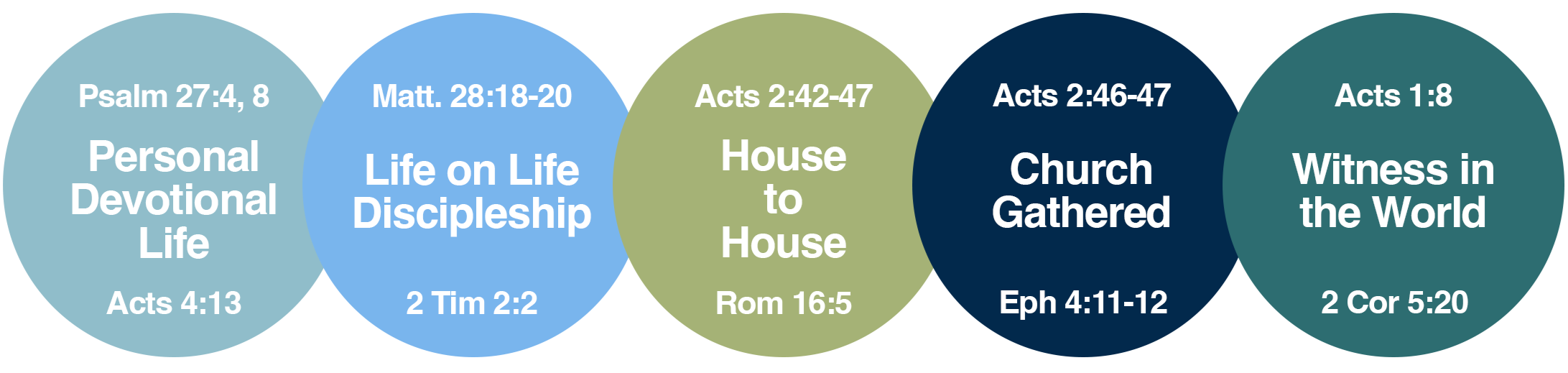
5 // How We Do It: The 5 Circles of a Healthy Church, each of which is activated through the Word of God, the worship of God, prayer and obedience:
Circle 1: Personal Devotional Life (Psalm 27:4,8 & Acts 4:13)
Circle 2: Life on Life Discipleship (Matthew 28:18-20, 2 Timothy 2:2)
Circle 3: House to House (Acts 2:42-47, Romans 16:5)
Circle 4: Church Gathered (Acts 2:46-47, Ephesians 4:11-12)
Circle 5: Witness in the World (Acts 1:8, 2 Cor 5:20)
In the US and Latin America, we express the 1—3—5 calling through the Antioch church model and, in other international contexts, the same calling is expressed with some regional variations. Typically, the Antioch church model requires a few years to fully develop so we don’t expect a church to fully implement everything right away. Instead, we view the following as the core components that each church seeks to establish as it matures.
A focus on Personal Devotion, with an emphasis on prayer, through disciplines and events such as church-wide fasts, Encounter Nights, freedom weekends, and consistent corporate prayer meetings.
The prioritization of disciple-making as the core ministry of the church. This occurs in House-to-House gatherings, generally called Lifegroup or House Church. These groups should then facilitate Life-on-Life Discipleship, typically through smaller groups of 2—3. We believe these house churches are the very heart of the church. We equip parents to make disciples of their children and believe discipleship starts in the home.
A weekly public service(s) for the Church Gathered that creates an environment to cast vision and lead both believers and unbelievers into encounters with God. As the church grows, churches may multiply congregations within a city to reach increasing numbers of people.
An Antioch Discipleship School that provides an intensive discipleship environment. These schools are foundational for our missions pipeline, our leadership development, and our next generation of U.S. church planters and staff.
The call for each believer to embrace their Witness to the World. This call includes the corporate witness of the church through a church-based missions department for local, national, and international outreach that, as a general goal, sends out at least one new church-planting team every few years. We self-fund these ministries by allocating 10-30% of our operating budget for missions. As part of this1.5% is donated by each church to support the operations of the Movement Support Office (MSO).
Although Antioch churches are found in a variety of places around the world, we feel a particular calling to focus on reaching the urban, young, and diverse population of our nation. Churches will contextualize to their city in significant ways around the core model listed above.
Section III
Antioch Values
These values describe key indicators of spiritual health. We pursue these values in our churches and personal life. Churches do not need to incorporate the language below, but we do want these values to be expressed in the life of the church.
Encounter: Look up (Love God)
We encounter God through daily Devotion
We are committed to the truth of God’s Word
We live and walk by the Spirit
We persevere in Prayer
We honor God with our Finances by working diligently, living simply, giving generously
We choose Obedience, even when it hurts
We walk in Holiness
Disciple: Look in (Love One Another)
We consider Family our first priority
We Honor others, in person and behind their backs
We choose Humility by focusing on “Him and them” above ourselves
We are committed to a Relational Culture
We embrace Brokenness
Mission: Look out (Partner in the Mission of God)
We commit to Discipleship through intentional investment in other’s lives as our main ministry
We pursue Evangelism, from our immediate sphere of influence to the unreached and unengaged
We are committed to the Local Church
We care for the Poor and those in crisis
We embrace God’s design for racial unity in Kingdom Culture
We bless the larger Body of Christ
Section IV
Antioch Doctrine
-
We believe that the Bible is the inspired, authoritative, living, eternally reliable Word of God equally in all parts and without error in its original manuscripts, and our primary and authoritative source of revelation from God, superior to conscience and reason, though not contrary to reason. Therefore, the Bible is our final authority for faith and practice and is necessary for our daily lives as it continually points us toward the person of Jesus (2 Tim 3:16-17; 1 Pet 1:23-25; Heb 4:12).
-
We believe in one God who has revealed Himself in three persons: the Father, the Son and the Holy Spirit (Rom 1:2). The Father, the Son and the Holy Spirit are all co-eternal, all stand equally superior to time, free from the temporal distinctions of past and future (FATHER – Deut 33:27; Ps 90:2; Ps 102:27; 1 Tim 1:17; SON – John 1:1-2; John 8:58; Heb 1:8; 1 John 1:2; Rev 1:8; SPIRIT – Heb 9:14).
We believe in God the Father, creator of all things visible and invisible. (Col 1:15-16)
We believe in Jesus Christ, God's only begotten Son, who came into the world to reveal the Father, and was the brightness of His glory and the express image of His person; that Jesus Christ is the Creator of everything, for by Him all things were made. We further believe that in Christ dwelt all the fullness of the Godhead bodily and that He is very God and very Man (John 1:1-2, 14; 1 Tim 3:16; Acts 7:37-38).
We believe in Jesus Christ's pre-existence, incarnation, virgin birth, sinless life, miracles, substitutionary and atoning death, bodily resurrection, bodily ascension into heaven, exaltation, present rule at the right hand of God, coming, personal return in power and great glory, and in His everlasting Kingdom and dominion (Acts 1:11; 3:19-21; Dan 7:14; Rev 20:4). We acknowledge His Lordship -- that Jesus Christ is Lord over all things in heaven and on earth, and under the earth (Phil 2:9-10).
We believe in the Holy Spirit, His present ministry, His indwelling, His empowering, His impartation of gifts for today, and His transforming power in the lives of all believers (1 Cor 12:4-11, Gal 5:22-23, Eph 1:13-14).
-
We believe that man was created by a direct and immediate act of God (Gen 1:26-27; 2:4).
We believe that man by transgression fell from a state of righteousness and holiness in which he was first created into total spiritual depravity, a state of death in trespasses and sins in which he is held as a slave of sin and an enemy of God. As such, he is unable to attain divine righteousness by his own efforts but must be redeemed and delivered by the power of the gospel (Rom 5:12-21; 1Cor 15:1-4).
We believe that repentance and faith toward our Lord Jesus Christ are an integral part of God's work of justification of the believer. Through faith in the shed blood of Christ, he or she is justified and made a partaker in the death of Christ (Rom 5:1, 9). We believe that "it is by grace you have been saved, through faith--and this not from yourselves, it is the gift of God--not by works, so that no one can boast" (Eph 2:8-9). We further believe that the emphasis for a continuous walk in grace should be on demonstrating righteousness and purity of heart, believing in the keeping power of God, walking after the Spirit and not after the flesh, living a lifestyle that demonstrates the character, standards and convictions of Jesus Christ, and not being conformed to the world (Jude 24; Rom 8:25; Gal 5:16-25; Rom 4:1-5; 12:1-2).
We believe that repentance is dependent upon the convicting action of the Holy Spirit in the lives of sinners and believers and their response. The conviction of the Holy Spirit, which often accompanies the preaching of the Gospel of Jesus Christ, will result in the revelation of the sinfulness of self, which should lead to godly sorrow and repentance. (2 Cor 7:10; Ps 51; Acts 11:18; 2 Tim 2:25; Rom 1:18-32; Matt 9:12-13).
We believe that in the final judgment, which will accompany the return of Christ, every person will give an account to God of every aspect of this earthly life. Unbelievers will be separated from God for eternity in hell. Believers will experience the final resurrection and live eternally with Christ in the new heavens and the new earth.
-
We believe in the Lord's Supper and believer's baptism as acts of our obedience and a testimony of our faith (Matt 3:6; Mark 16:16; 1 Cor 11:23-29).
We believe that water baptism is necessary in obedient response to the command of Jesus. Baptism is to be performed only upon repentant believers in the name of the Father, Son and Holy Spirit. (Matt 28:18-20).
We believe in the baptism of the Holy Spirit according to Acts 2:4; 10:46; 19:6. We hold that the real evidence of the baptism of the Holy Spirit is one's response to the Word of God (John 16:13), a Christ-like life, showing forth Christ's character, and experiencing and manifesting the gifts and fruit of the Holy Spirit (John 15:26; 16:14; Gal 5:22-23; 1 Cor 12:4-11).
-
We believe that God has ordained the family as the foundational institution of human society. Marriage is the uniting of one man and one woman in covenant commitment for a lifetime. The husband and wife are of equal worth before God, since both are created in God's image (Gen 1:27). Children, from the moment of conception, are a blessing and heritage from the Lord (Gen 2:20-25, Matt 19:4-6, Ps 139:13-15).
-
We believe the Church is both universal and local. All believers form the Church, in unity with all believers throughout history; and yet, the church is also local, with believers gathering in committed community and under the authority of Christ (Eph 1:21). Scripture describes the Church as the Body of Christ (Rom 12:5, 1 Cor 12:12-31, Eph 1:9-10, 22-23), the Household of God (Rom 8:14-17, Gal 3:26-4:7, Eph 2:11), the temple of God (1 Cor 3:9-17, Eph 2:21-22, 1 Pet 2:4-10), and God’s chosen people (Rom 11:17, Gal 4:28-31, Eph 2:19). This language is intimate and reveals Jesus’s commitment to and care for His people. Furthermore, the church is God’s instrument for revealing His purpose on the Earth (Eph 3:10) and the fullness of Jesus on earth (Eph 1:23) for His glory.
Summary
We ask all Antioch lead pastors to affirm our doctrinal statement. If at any point a pastor is no longer able to affirm the entirety of this statement, we ask him to initiate a conversation with the church’s External Advisors.
Position and Guidance Papers
Position papers outline Antioch’s stated positions on additional topics. Our goal is to limit the number of official position papers and to release new positions only after a collaborative drafting process. These position papers are binding for Antioch churches and leaders.
Pastoral guidance papers provide wisdom regarding sensitive topics. Guidance papers are not binding but they generally reflect the stance and direction of Antioch.
Section V
Antioch Meeting Rhythms
We believe that we are better together, and there is no substitute for time spent in worship and face-to-face connection. Events always feel like a sacrifice but, once we are there, our constant testimony is “I’m so glad we did this!”
The following rhythms represent the normal event cycle for the Antioch Movement and how to prioritize. Our main conferences occur on a two-year rotation, and we intentionally alternate to space out the cost.
Main Conferences (these are required for all Antioch Churches):
USCON – Occurs every other year, generally in Waco, and is open to all staff and elders at Antioch US Churches. At a minimum, we ask all lead pastors to attend; however, we highly encourage you to bring your whole team.
Team Leader Gathering – Occurs every other year, generally in an easily accessible international location. We ask all lead pastors to attend. If your church has multiple overseas teams, we invite your Missions Director.
Roundtables (these are highly encouraged for all Lead Pastor couples)
Roundtables occur on an annual basis. These are for Lead Pastors, and there is both a men’s and women’s Roundtable (at different times). We highly encourage everyone to be involved and for churches to pay for their lead pastor couple attend their respective Roundtables (normally near Waco). Pastors are assigned to a permanent Roundtable.
Ministry Cohort Gatherings (these are encouraged for relevant staff)
Ministry Cohort Gatherings are annual or every other year events for ministry areas such as worship, kids, youth, ADS, etc. On USCON years, Ministry Cohort Gatherings will be immediately before or after the conference to reduce travel costs. Because of the cost, these gatherings are not required, but we do encourage them as a significant way to develop your staff.
Cohorts generally provide ongoing communication, resources, and virtual meetings in addition to the gatherings. The cohort gathering cost varies group-to-group, but generally travel is the largest expense and accommodations are provided.
Regional Conferences (required for missionaries, and encouraged for Missions Directors if you have people in the region)
We host three regional conferences (rCONs) for international missionaries. One for the Middle East, Europe, and Africa; one for the rest of Asia; and one for Latin America. All international missionaries are required to attend their relevant conference. Sending churches are highly encouraged to send a representative if they have missionaries in the region.
Kids and Youth ministry is one of the most important aspects of these events since most missionary kids have little/no access to this during normal life. To facilitate this, we ask sending churches to send volunteers according to the number of kids or youth represented from their church. This ratio is communicated in advance to each sending church.
Section VI
Missions Agreement
The goal of this agreement is to facilitate disciple-making and church-planting through the local church as part of our Movement’s commitment to world evangelization in a way that leads to increased health and unity as we partner together. Antioch Missions is a relational network consisting of shared and agreed-upon structures and processes created by our International and US Oversight Team and facilitated by the International Field Office (IFO) and Movement Support Office (MSO). The goal is to create equity amongst field staff and to support each church in effectively owning the training and sending process while honoring and utilizing the experience and knowledge of our field leadership. Churches agree to the following items when sending international workers:
Application process – All field staff utilize the standard Movement Field Worker Application.
Church planting calling – While there are a variety of contextual models and bi-vocational approaches, the calling of the Movement is to plant churches; therefore, all Antioch teams are engaged in church planting as a primary focus.
Vetting – All field staff will be evaluated by the standardized evaluation processes detailed in the Missions Staff Sending Process Requirements Checklist.
Training – All field staff will graduate from an Antioch Movement Discipleship School (ADS) that subscribes to the agreed upon Movement standards, complete the Church Planting Intensive (CPI), and complete either the Church Planting Mentorship or Church Planting School. SERVE interns must complete an ADS.
Location alignment – Because the work of one team can impact others, the sending church will communicate and coordinate with the IFO/MSO and regional Area Strategy Leader (ASL) to discuss key issues including deployment location, opportunities for partnership and strategic alignment, how the new team should represent themselves to locals and the missions community, and how to coordinate with other teams in the country.
Strategic alignment – The strategy for any new team sent out by a sending church is determined by the Team Leader in consultation with the sending church and the appropriate field leadership. For direction on who to consult with to form an agreed upon effective church planting strategy for that area, email mobilization@antioch.org.
Ongoing strategy – The International (IFO) Director and ASLs provide the primary ongoing strategic input for Team Leaders on the field. Team Leaders receive strategic input on an ongoing basis through regular connections with their Coaching Group and ASL. For major strategic decisions (ex. change in strategy, personnel, location, etc.), the IFO and ASL will loop in the sending church missions staff into the decision-making process.
Field Manual – All field staff are required to review, sign, and abide by the Field Manual. This includes adherence to the child safety policy, conflict resolution protocol, and vacation and time off standards. In issues of conflict on the field, the sending church agrees to abide by the conflict resolution protocol.
Multi-Church Teams – Teams are from the sending church from which the Team Leaders are sent. In the case of a team composed of members from multiple sending churches, representatives from the sending church should coordinate with the Team Leaders (and in some cases the ASL, International (IFO) Director, and Team Leader sending church) regarding any input they would give field staff related to their field-based activities and responsibilities.
Seconded Teams – Seconded teams are Antioch teams that are committed to the authority of another organization or another organization’s team committed to the authority of an Antioch team.
Security standards – Agree to abide by relevant security standards.
Member care – Incorporate the Movement’s member care standards, as outlined in the “six pillars of member care” to provide excellent, life-giving care, covering, and connection for field workers, helping them thrive on the field. The sending church will own responsibility for providing pastoral care for Field Staff, while Team Leaders will ensure pastoral care for members who join their team. This pastoral support from sending churches includes monthly pastoral conversations between field staff and their Pastoral Overseers (POs) as well as periodic onsite visits. In addition, there is a field-based pastoral care team to provide supplemental and ongoing pastoral care.
Team Training - The sending church and IFO (MSO, if Latin America) will partner together to equip teams to ensure healthy relationships and effective functioning. For new Team Members and Team Leaders launching, utilize the “Team Building Essentials” process for Team Leaders and “Team Members Being Added” process for Team Members.
AMI missions support structure – All field staff will integrate within the Antioch Movement Missions infrastructure, including joining the First Term Track (for first term field workers), participating in coaching groups (for Team Leaders), participating in additional on-the-field training, and receiving expert counsel and guidance from ASLs and Field Leadership. See “Field Base Support” for more information.
Events – All field staff will attend their respective rCONs and, if applicable, Team Leader Gatherings. The sending church will provide childcare workers to these events in accordance with the number of children represented from their church.
Finances – We encourage the following for international teams:
All field staff are encouraged to tithe to a team account for their team’s ministry purposes as an expression of them giving to the “local church.”
Because the IFO exists to support Antioch’s church planting teams and is funded by our church network, we ask that teams prayerfully consider a voluntary portion of the available team account funds (recommended 15-20% annually) to contribute regularly towards the costs of the IFO providing support for our teams on the field. We realize that each team has unique circumstances, so the IFO is available to discuss with teams on an individual basis what an appropriate contribution amount might be for their situation.
Sending churches may be asked to cover financial costs incurred by the IFO (MSO for Latin America) for unplanned trips to discuss key matters or handle emergency issues that the sending church cannot adequately address.
Most of this document refers to teams that seek to catalyze movement in their location, including the guidance for financial support of the IFO. The approach is different for Established Churches within the Antioch Movement, who are asked to donate 1.5% of their tithe income to the MSO to fund operations (this generally applies to our work in the United States and Latin America).
Section VII
US Church Planting Agreement
The purpose of this document is to provide clarity of expectations regarding new church plants within the Antioch Movement. Our heart is empower churches to plant churches according to our apostolic calling. As we pursue this ministry together, we believe it is important to clarify basic standards and commitment to ensure long-term alignment and unity in our growing movement.
Lead Pastors (the following are required for new churches and/or the installation of a new Lead Pastor):
Every Lead Pastor has completed ADS prior to planting. Existing Lead Pastors and elders are committed to doing ADS within 1-2 years following their installation if they have not done so already.
Every Lead Pastor is centrally trained in Antioch vision, values, doctrine, and governance. This training is facilitated via a 4 day US Church Planting Intensive (hosted by the MSO) for new church planters in the Movement and supported by additional videos and documents. All pastors sign an agreement affirming their adherence to Antioch’s vision, values, doctrine, governance & position papers.
Every Lead Pastor is clear regarding the expectations of an Antioch church. The Region is responsible for onboarding new pastors in their region. All new churches need to be named ANTIOCH, unless they are “grandfathered” under the church planting banner of Epicentre, Mosaic, CrossBridge, Paradox, or Waypoint.
Regional Leadership:
Every new church is birthed from or placed in a Region in accordance with Antioch governance and the regional structure. The Region works with the new church to establish governance, strategy, rhythms of meeting, child safety protocols, and care for the Lead Pastor and Team.
Every Region facilitates a training process for new Lead Pastors (training protocols are currently being developed). The primary process for training new pastors is the US Leadership Track, but this is not a requirement for Movement pastors. If a prospective Lead Pastor has not participated in the US Leadership Track, then the Regional leadership team must affirm that the new Lead Pastor has received adequate preparation for the role.
Every Region vets for the 4 C’s.
Character – Lead Pastors should demonstrate: a vibrant walk with the Lord, holiness and Christlike character, emotional health, a healthy marriage and family (if it applies), diligence and a strong work ethic, and wise stewardship of their finances (I Peter 5; I Timothy 3; Titus 1).
Competency – Lead Pastors should demonstrate: an ability to lead a team into a vision, a track record of multiplying disciple-making, competence in pastoral care and preaching, and experience in ministry leadership (Romans 12:8).
Culture (Antioch values, etc.) – Lead Pastors should have served in a leadership capacity in an existing Antioch church for 2—3 years. This timeframe allows for the space needed to discern relational depth, calling, and the culture of the Antioch Movement (I Timothy 5:22).
Capacity – Lead Pastors should possess the capacity to grow in managing multiple responsibilities and initiatives in at the same time. Lead Pastors should display a healthy emotional capacity for church leadership, grace to lead his family, managing a sustainable schedule, and an overall grace for church leadership (2 Corinthians 11:28). Capacity is particularly important for bi-vocational Lead Pastors who need to balance family, church, and a job.
The Movement Support Office
Establishing new regions (and the eventual move to “super regions”) and ensuring all regional leaders are properly onboarded and equipped for the role.
Facilitating inter-regional church plants. In such a situation, the receiving region must approve the new plant and will serve as primary oversight for the new church.
Identifying potential new regions/plants in major metro areas where we don’t have a presence (specifically, but not limited to NY/Philly, Atlanta, Ohio, Minnesota/Wisconsin, Tennessee). If a church intends to plant a church in an area in which we do not yet have an established region, the sending church must inform the MSO, who will then coordinate with the USOT to seek approval.
In order to support the work of church planting, the MSO provides the following resources:
US Leadership Track (USLT)—The USLT provides the primary training process for new Lead Pastors, as well as for others with a call to pastoral leadership. This program has a standard two-year option, or a three-year option with a Masters Degree. The USLT equips pastors according to the requirements of a Lead Pastor in vision & values, capacity, and character.
US Church Planting Intensive—This intensive provides vision & values training as well as coaching for new churches that are launching within one year. The USCPI (new name TBD) includes coaching resources for the practical aspects of establishing a new church.
Application process for Lead Pastors —The standard application process helps to facilitate important conversations as part of the vetting process for a new Lead Pastor.
Pastor Roundtables—The Roundtable is an annual retreat for Lead Pastors to interact with, support, and learn from one another. We highly encourage every pastor to participate.
Resources for churches—In addition to these systems for new churches, the MSO provides the following resources: elder training videos, guide for church mergers, guide for church closures, guide for installing a new pastor, cohorts for ministry leaders (kids, youth, worship, college, Training School Directors & MD’s), sabbatical coaching and more.
Section VIII
US Church Governance and Polity
Scripture describes the church as the Body of Christ, with Jesus Himself as the Head. The church is the temple of the Holy Spirit, filled with God’s presence and with Christ as the cornerstone. The church is not a human institution, but rather is the household of God the Father, submitted to the lordship of Jesus, and constantly led by the Holy Spirit.
These theological truths—like all good theology—are more than just a statement. They must be lived out, and this raises big questions: How should the church organize and operate? How does the church submit to Christ and the leadership of the Spirit? What is the role of human leaders?
The Bible is clear on the theological reality, but the application in a particular cultural context can be tricky. The conversation describes polity, or church governance, and it can get complex because there is no clear consensus either biblically or in church history regarding how church leadership should be structured. Instead of a specific model, we see consistent themes that are represented in historic forms of church governance: episcopal (bishop/apostle-led), presbyterian (elder-led), and congregational (member-led).
We see merit and biblical support in each of these approaches and seek to incorporate elements accordingly. Ultimately, Christ is the Head of the Church, and the Holy Spirit is the One who leads. All forms of human governance have one goal: to follow Him. We recognize that any model can become corrupted by the sin of its human agents. Likewise, God can move through any model of church leadership. More than perfecting a “model” we instead seek to be people who live fully submitted to Him, and we trust the Spirit to work through broken vessels.
The Antioch Governance Model:
Local churches are elder-governed because we believe that no one person is ever provided with complete revelation, and that we need one another to discern God’s will. We seek to establish mature (1 Tim 1:1-7) and diversely gifted elder teams (Eph 4:7-16) who are responsible for overseeing the church as it follows the leadership of the Spirit (Acts 14:23).
Local churches are senior pastor-led* because we believe God calls certain people to provide leadership to help guide the church into its calling (e.g., Acts 19:1-10, Titus 1:5). Church leadership should resemble the leadership of Jesus (Phil 2:1-11, John 13:1-20).
*The term “pastor” is used because it is the common speech of our culture. It is not meant to privilege one type of spiritual gift (pastor or teacher) over others, such as the evangelist, prophet, or apostle. We refer to “lead pastor” as a point leader who leads a diversely gifted team for the sake of empowering the whole church for ministry.
Local churches seek to empower the whole congregation in the various spiritual gifts for the work of the ministry because we believe that God imparts His gifts to each person, and that each person has a part to play in God’s purposes (Acts 2:17-18, 1 Cor 14:26, Eph 4:7-16, 1 Peter 4:10).
Local churches are accountable to an external advisory team for both counsel and to preserve the unity of the church’s leadership because we recognize that sometimes elders get bogged down in conflict, sin, or a dispute regarding direction (Acts 15:1-2). The external advisory team is comprised of leaders within the Antioch Movement who regularly pray for and speak into the life of the church. They are empowered to resolve disputes among the elders when it becomes apparent that the church is at an impasse. External Advisors are appointed according to the Antioch Movement’s regional structure in the United States.
-
For more on Elders, visit antiochresources.com for our Elder Training Video series.
The Role of Elders
Elders serve with the Lead Pastor to seek God together regarding the governance of the local church. They provide this leadership through setting an example with their lives, providing pastoral care for both the church and the staff, overseeing the church, and consistent intercession.
Biblically, elders should have the qualities outlined in 1 Timothy 3:1-13 and Titus 1:6-9. Elders should demonstrate Godly character, a commitment to the Antioch vision, values, and mission, the ability to provide spiritual oversight, and an attitude of mutual submission and love. They should also have the capacity to fulfill the role.
Churches should avoid appointing elders due to family ties, historic financial contributions, influence within the church and tenure of involvement if the above qualities are not fully present. Elders can be either staff or non-staff, and we encourage at least some non-staff representatives on the elder team.
As churches grow, the authority of the elders will need to be delegated to the staff in increasing measure. In large churches, elders provide oversight and general direction, but the staff primarily exercise these delegated responsibilities and are managed by the senior pastor or the management team of the church.
Process of Appointing Elders:
The Antioch Movement provides an elder training retreat template for use in the formation of new eldership teams. This includes a video series and a sample job description.
The External Advisors must approve the formation of the first elder team. Following this initial formation, elder teams are self-selecting.
Scripture exhorts us to “not be hasty in the laying on of hands” regarding the appointment of elders. We encourage churches to wait until a person exhibits the necessary character qualities and trust from the congregation before they are appointed. In other words, the title of elder should only be given to someone who already acts like an elder.
Most churches will gradually appoint elders by first creating a “pastoral advisory team,” followed by a “pastoral leadership team” that assumes the various roles of elders but within clearly defined term limits. We encourage the formation of some local team as quickly as possible. Prior to the formal commissioning of elders, the local advisory/leadership team will partner with the External Advisors to fulfill the role of eldership.
The congregation should be given a chance to provide input prior to the appointment of elders. Generally, this is a public announcement and providing 30 days for church members to give feedback.
Elders should meet at least monthly and serve in a visible role within the church. Elders should seek to make unified decisions; if the Elders are stuck in an irresolvable dispute or place of disunity, then the External Advisors hold authority to intervene and decide. We define an “irresolvable dispute or place of disunity” as a situation in which a) either 2 or more elders or b) the Lead Pastor is unable to agree to a decision or is in a state of conflict that they do not believe is capable of being resolved without outside intervention. If a) either 2 or more elders or b) the Lead Pastor determine intervention is necessary, they must first inform the other Elders and then they are free to initiate with the External Advisors. At this stage, the External Advisors function as the final decision makers for the church related to the situation.
Within the Antioch Movement, churches are given the freedom to either allow or not allow women to serve as elders. This should be decided based on careful study of the Scripture. Churches should be careful when appointing the spouse of the lead pastor. This should only be done because the spouse exhibits the gifting and the qualities of an elder and has the capacity to fully fulfill the role. Please refer to our Women in Ministry position paper.
The local eldership team does not hold unilateral authority to remove the Lead Pastor, but they can bring concerns to the External Advisors who are empowered to investigate and ultimately either remove or adjust the role of the Lead Pastor.
-
The Antioch Movement is governed by the US Oversight Team, which provides leadership for the Antioch Movement in the United States as well as a few churches in Europe and Latin American. This team functions as elders for the Movement but is not a decision-making body for individual churches. That is the responsibility of the local eldership and their respective External Advisors.
Antioch’s U.S. network is organized into distinct regions to better coordinate and support member churches. The primary authority of Regional Teams related to individual churches is exercised through the existing model of External Advisors. In other words, our governance model has not changed through the regional structure. What has changed is how External Advisors are appointed, and certain responsibilities of the U.S. Oversight Team that have been pushed to the regional level.
Specific Responsibilities of the US Oversight Team:
Approve any stances made on behalf of the Movement (together with the Field Oversight Team), along with the input from Antioch US Pastors.
Oversee the systems, philosophy, and training for new US church plants.
Oversee the Movement-wide support systems to ensure they appropriately represent the vision and values of the Movement.
Determine issues of affiliation or disaffiliation among member churches.
When making decisions related to movement values, doctrine, and positions, the US Oversight Team will do everything within its power to provide a clear feedback process for each church in order to best represent the Movement. The team will seek to minimize the number of mandates given to churches and instead focus on training and supporting member churches and their respective External Advisors as they make decisions related to ministry practice and direction.
Specific Responsibilities of the Regional Leadership :
Approve new church plants in the region.
Stay informed and receive the opportunity to provide input on significant local church transitions (especially pastor transitions, church mergers, or closures).
Appoint External Advisors for churches in the region. A regional leader should serve as the President for each External Advisory team.
Collaborate with member churches to develop a shared apostolic vision for the region.
The US Oversight Team is self-selecting. Most USOT members also serve as Regional Leaders (though this is not a requirement). USOT members generally have 7+ years of leadership experience within Antioch.
-
The main external oversight structure for Antioch Movement churches is an External Advisory team for each church. Each church is required to establish External Advisors in accordance with our structure and prior to its launch. Our desire is to plant autonomous churches while maintaining strong friendship, partnerships, and accountability.
The Regional Leadership Team in the new church’s location approves the External Advisors, including a regional leader who serves as the president of the External Advisors Team. The sending church generally provides some of the External Advisors but is not responsible for oversight once the church has been launched. For example, a church sent from Waco is overseen by its respective External Advisors, not by the pastoral staff in Waco.
The External Advisors’ role shifts with the maturity of the church. During the church plant stage, the External Advisors maintain an active role in oversight. Once the church establishes local elders, the team shifts to an advisory role but maintains final accountability for disputes among elders.
External Advisors are distinct from a church’s Board of Directors. The Board of Directors is a legal group to oversee the finances of the organization. Typically, this Board is comprised of key staff and/or elders.
Role of External Advisors During the Launch and Church Plant Stage:
Partner with a local pastoral advisory or pastoral leadership team to approve strategy, pastoral hires and budget (de facto elders)
Oversee the ongoing growth, health, and development of the Lead Pastor
Provide accountability for:
The development of Antioch values and ministry practices in the new church
The establishment of healthy church structures
The health of the church-planting team
The ongoing maturation of the new church
Once the church is established (see above for criteria):
Provide input and mentoring for the lead pastor and eldership team.
Provide oversight and accountability for the spiritual and relational health of the lead pastor and their spouse (together with local elders).
Exercise decision-making authority for unresolved conflicts amongst the eldership team.
Exercise decision-making authority for removing or suspending the lead pastor due to moral failure, leadership failure, health requirements, or other factors necessitating potential change.
Partner with local elders to set the lead pastor’s compensation.
Provide pastoral care for the Lead Pastor and spouse.
Guidelines for External Advisors
Suggested size of 3-5 people.
The Lead Pastor may suggest External Advisors, but External Advisors are formally approved by the Regional Leadership Team.
A member of the Regional Leadership Team must serve as the President for each External Advisory Team.
External Advisors must come from the Antioch movement for all new churches; existing Advisors are “grandfathered” in.
External Advisors should meet at least once a year.
External Advisors may only be added or removed through the approval of the remaining External Advisors, the local leadership (Lead Pastor and Elders), and the Regional Leadership Team.
Advisors should be available on an as needed basis throughout the year and commit to attend the annual meeting.
Advisors of newer churches should maintain additional availability to serve in a more involved oversight function.
Advisors must be ready to provide intensive support in the event of a) elder conflict, b) concerns about the Lead Pastor’s leadership, and c) Leadership Transitions. Each of these requires significant involvement, and it is important that External Advisors are available and prepared to serve. If External Advisors are not able to provide this type of support, then they should step down from their role.
Church’s response to their External Advisors:
Quarterly Updates – Provide updates on a quarterly basis to communicate the current condition of the church, how the church is doing, and the goals for the season.
Annual Report – Send a report prior to the annual meeting, including a schedule, key questions and agenda items, update on initiatives, general update with the following: overall Sunday attendance, growth from the previous year, number of Lifegroups, training school attendance, potential long-term church planters, and a financial report.
Hospitality – Ask each External Advisor if they would like to stay in a home or hotel when they come to serve. Different ones have different needs at different times so please be sensitive to them coming and serving you.
Reimbursements –Travel reimbursements should be issued as a separated check and should include mileage reimbursements for anyone driving (check the annual IRS employee reimbursement rate). Please consider other travel expenses, such as airport parking or gas for rental cars, when issuing a reimbursement check.
Honorariums – A normal External Advisors honorarium ranges from $250 to $300. Please consider an additional honorarium if they are asked to extend their stay to preach, teach in a training school or provide staff consulting. As always, if your church is not at a place to do that, communicate in advance and continue to serve them, bless them, and do everything you can to make their time as comfortable as possible.
General Accessibility – The External Advisors represent part of the oversight for the church. The Lead Pastor and staff should respond to them appropriately by responding to a correspondence and recommendations in a timely and diligent manner.
External Advisors are meant to be a resource for advice in church planting and pastoral care for the pastor. External Advisors should review the following topics on a regular basis:
Lead pastor health (spiritual, family, physical, financial)
Team health (staff and elder)
Staff effectiveness and needs
Church strategy
Church structure
Church finances
Potential concerns
A few practical implications:
Elders are responsible for the doctrine, values, vision & direction, staff, church discipline, unity, and budget for the church. They are an example to the church through the integrity of their life, they shepherd the church through pastoral care, and they lead the church by seeking the Holy Spirit in prayer regarding their responsibilities.
Elders carry their authority in unity together as a team. We encourage elders to strive for “consent decision-making.” This is not consensus—our model encourages healthy discussion and even debate—but ultimately asks the group to mutually submit to one another. In other words, one elder may have a different perspective or preference, but they will submit to the other elders and represent a unified leadership to the church. In the event that the elders cannot consent to a decision, the elders will ask the External Advisors to facilitate a process to bring the team back into unity.
A lead pastor is the lead elder, which means they serve as a “leader among equals.” The lead pastor exercises his authority in unanimous unity with the other elders. In the event of disunity or a dispute, the External Advisors will mediate and are empowered to make final decisions and to bring the elder team back into a place of unity.
Lead pastors are responsible for the day-to-day ministries and operations of the church, including: leadership of the staff, the implementation of the vision, and the overall health of the church’s ministries.
Members do not have a formal “vote,” and this is done intentionally to avoid politicking within the church, but elder teams are strongly encouraged to include members in the decision-making process by recognizing that the purpose of ministry is to empower the whole church, and that the Holy Spirit speaks through the whole church.
External advisory teams hold a primary responsibility to provide godly counsel and pastoral care for the lead pastor couple. In the event of an ongoing elder dispute, the external advisors are fully empowered to mediate a process to restore the church to unity.
Antioch is a church planting organization, and we take seriously Paul’s charge to “not be hasty in the laying on of hands” when appointing elders. This creates a tension in new churches who require leadership but may not be ready to establish elders. Each church is different, but we navigate this challenge by encouraging the formation of a pastoral leadership team to generally oversee the church, while also increasing the responsibility of the external advisory team until elders can be appointed.